Grim Fandango: PointyClicky Edition
The afterlife. Finally on point.
An unofficial mouse-control mod. Requires your own copy of Grim Fandango. Not affiliated with or endorsed by the game's rights holders.
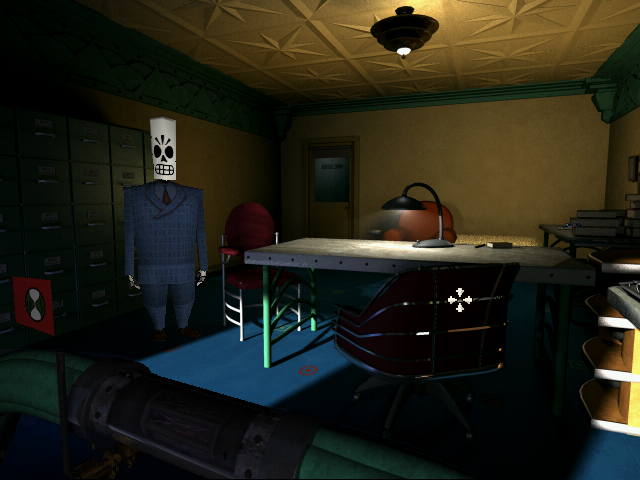
Grim Fandango came out in 1998, LucasArts' first adventure in 3D. It is one of the best games ever made, and you played it with the keyboard: arrow keys to steer Manny like a car, a key to use, a key to look. Tank controls.
This is Grim Fandango played by pointing: tap where you want Manny to go, tap a thing to use it. All of it, from the Department of Death to the end of the Ninth Underworld, as if it had always been made that way.
Why another one?
People have tried before, and we owe them. In 2014 Tobias Pfaff's Grim Mouse showed a pointer could work, and drew hotspots by hand for almost every scene. In 2015 Double Fine's Remastered added a pointer of its own, with new art.
We wanted something different: the original game, its own 1998 look, and a pointer built from the game itself rather than drawn over it. Nothing guessed, and nothing added that the game doesn't do.
What makes it different
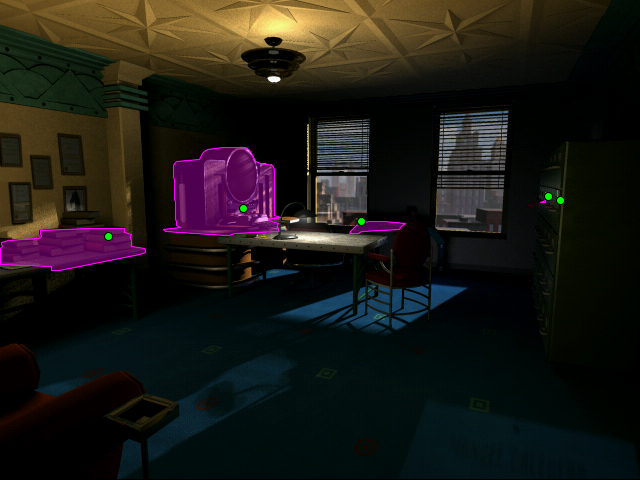
The game draws its own hotspots
Every object Grim can show is in its own scripts, with its position in 3D. Every camera angle comes with a depth picture of the scene. We read both and trace each thing's outline from the game's own data, then check every one against where the game says it is. Grim Mouse's hand-drawn outlines missed 305 things the game can show. Tracing from the game itself has closed nearly half already, and the rest are on the list.
Manny still finds things
In 1998 Manny's head turned towards anything worth a look. That was how you discovered the world, and it had charm. It still is: no labels, no flashing. Once he has noticed something, the pointer lights up over it, and only then.
Nothing invented
Every tap does something the original player could do with the keys: use, look, pick up, walk out, choose a line. So every line Manny says and every puzzle is exactly as LucasArts wrote it.
The details
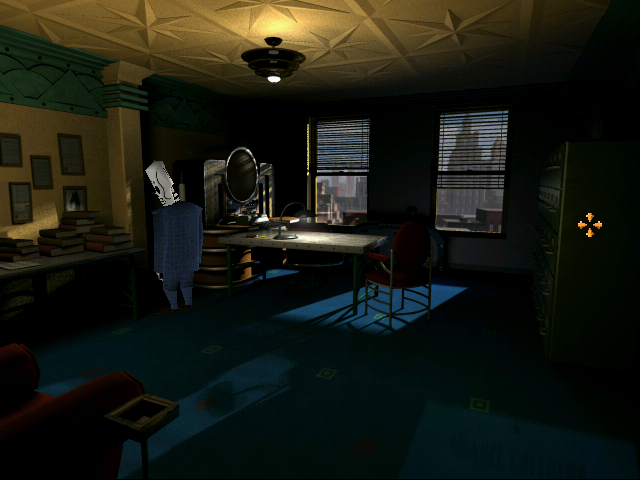
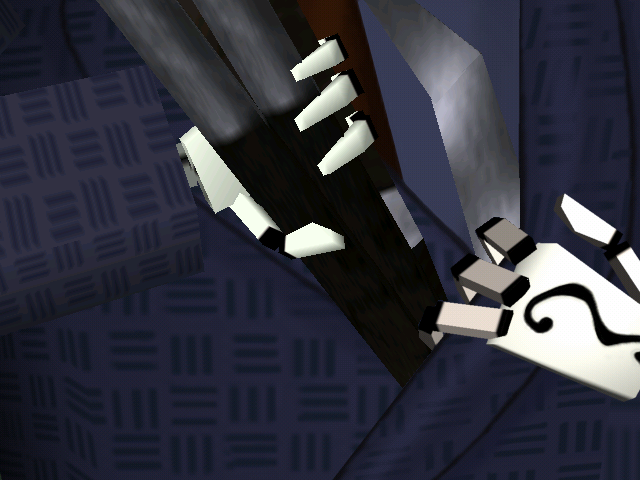
The pixels are the original's, drawn at Grim's own 640 by 480 and scaled up sharp. The cursor is a bone, in Manny's own bone colours. The controls are two: a tap, and a tap with two fingers to look.
Built in the open
The PointyClicky Edition is free software under the GNU GPL, its own project: the engine changes for ScummVM, the hotspot data, the scripts and the tools that read the game to make them. It builds on Grim Mouse by Tobias Pfaff, credited throughout, and on ScummVM, which makes Grim playable at all.
Where it's at
Walking, using, looking, running, Manny's head and his coat all work. Every vehicle goes where you tap: the Bone Wagon, the forklift, the crane, the ship. Still to come: the other moments where the game takes over the controls (the machines, the climbs, the fire extinguisher), the last outlines, and a full playthrough from the first scene to the credits by pointer alone, to prove it.
It comes to PointyClicky on iPhone as it's finished. Grim Fandango is in the app today as an experiment.